Kids Playhouse Company
Company
Shop By Category
T&Cs
Shop Online
  • Playhouses, tents, swings and learning toys for children 0 to 10
  • Free delivery across Australia on orders of $75 or more
  • Delivery within 7 working days of dispatch
  • Secure checkout by card or PayPal

Magnetic Tiles | Magnetic Building Blocks | STEM Building Toy

120-Piece Magnetic Tiles STEM Building Set

$99.99
  • 120 Piece Set
  • Mixed Shape Mix
  • Ages 3 to 14
  • Brand Compatible

Price: $99.99

  • Delivery time: up to 7 working days by tracked courier, after dispatch within 2 working days
  • Free delivery across Australia on orders $75+, otherwise $27.50 including GST
  • Pay by card or PayPal, handled by the payment provider
  • 15 days to change your mind, plus your statutory rights
Product specifications
Set Name120Pcs Magnetic Tiles
Number of Pieces120
Size120 Pieces
Number of Packs1
Material TypePlastic
ColourRed, Blue, Yellow, Green and more
ThemeEducation
Toy Building Block TypeMagnetic Toy Building Block
Educational ObjectiveCognitive Development, Creative Thinking
Recommended Age36 months to 14 years
Included ComponentsInstruction Manual
Assembly RequiredNo
Operation ModeManual
Customer Package TypeFFP
Item Dimensions33.6 x 24.3 x 9.9 cm
Shipping & returns

Tracked delivery anywhere in Australia. It is free on orders of $75 or more, and $27.50 including GST below that. Allow up to 7 working days in transit after dispatch within 2 working days.

Our store policy accepts change-of-mind return requests within 15 days of delivery. You cover return postage unless the item is faulty or we agree otherwise. This policy does not limit your rights under the Australian Consumer Law.

If it arrives faulty, damaged or not as described, we put it right at no cost to you under the Australian Consumer Law, return postage included.

Shipping details · Refunds and returns

120 Piece SetEnough shapes for two or three children to build at the same time.
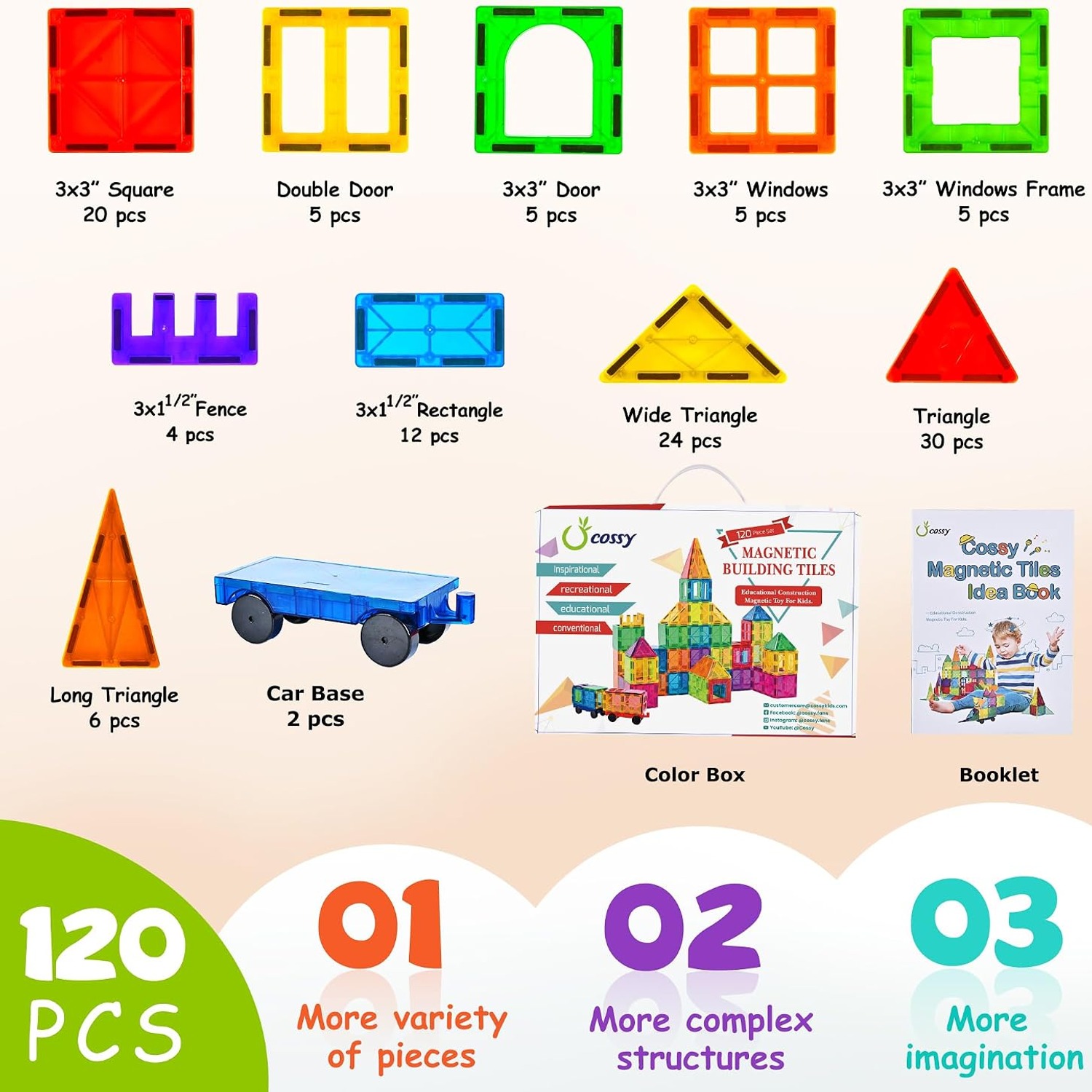
Mixed Shape MixSquares, windows, triangles, rectangles and two car bases in one box.
Ages 3 to 14Manufacturer recommended for 36 months up to 14 years.
Brand CompatibleWorks alongside other magnetic tile sets you already own.

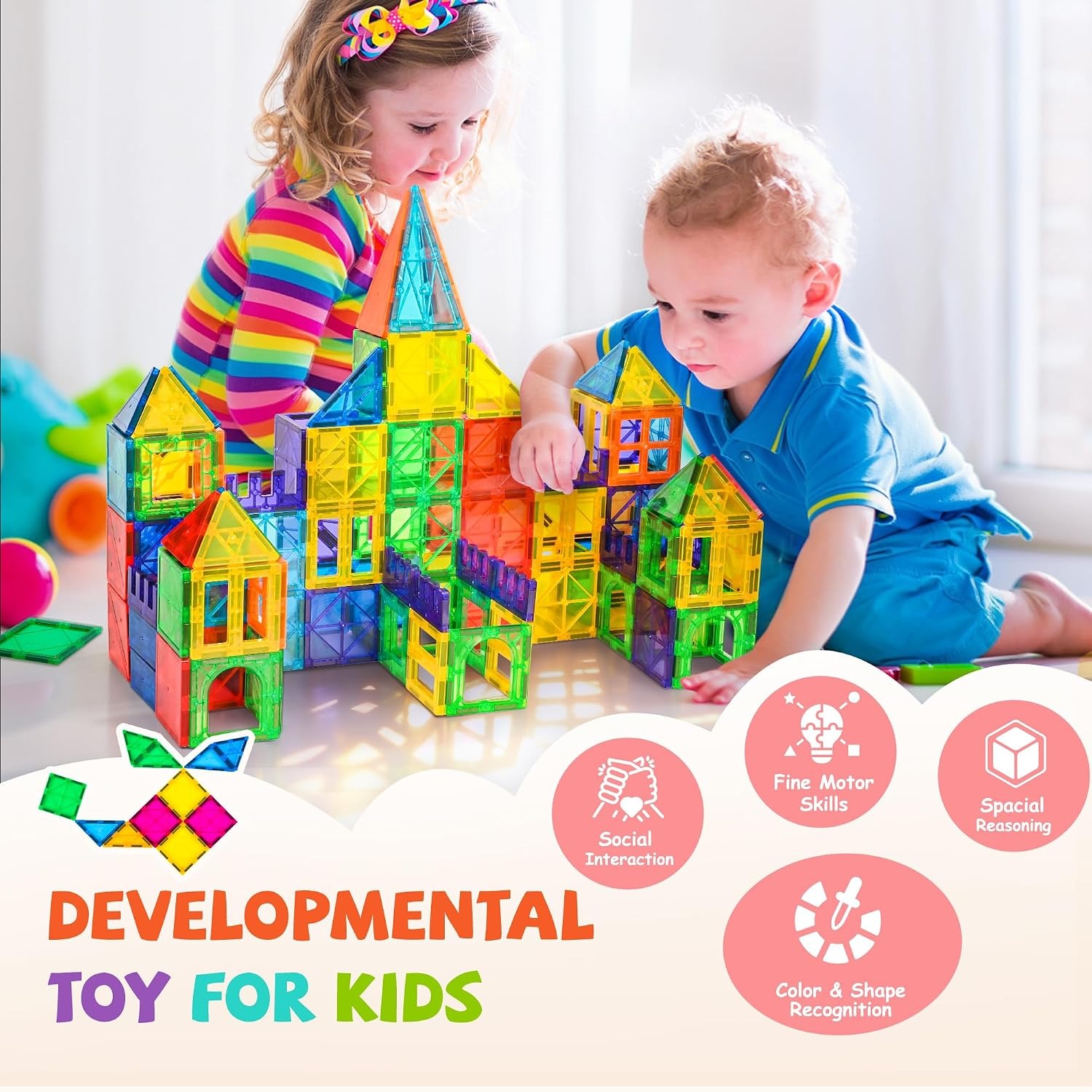
Turn a rainy afternoon into a city, a rocket or a castle with magnetic tiles that click together in seconds.

A 120-piece set of squares, windows, triangles, rectangles and two car bases, made from plastic with rounded corners, designed for ages 3 to 14 and compatible with other magnetic tile brands.

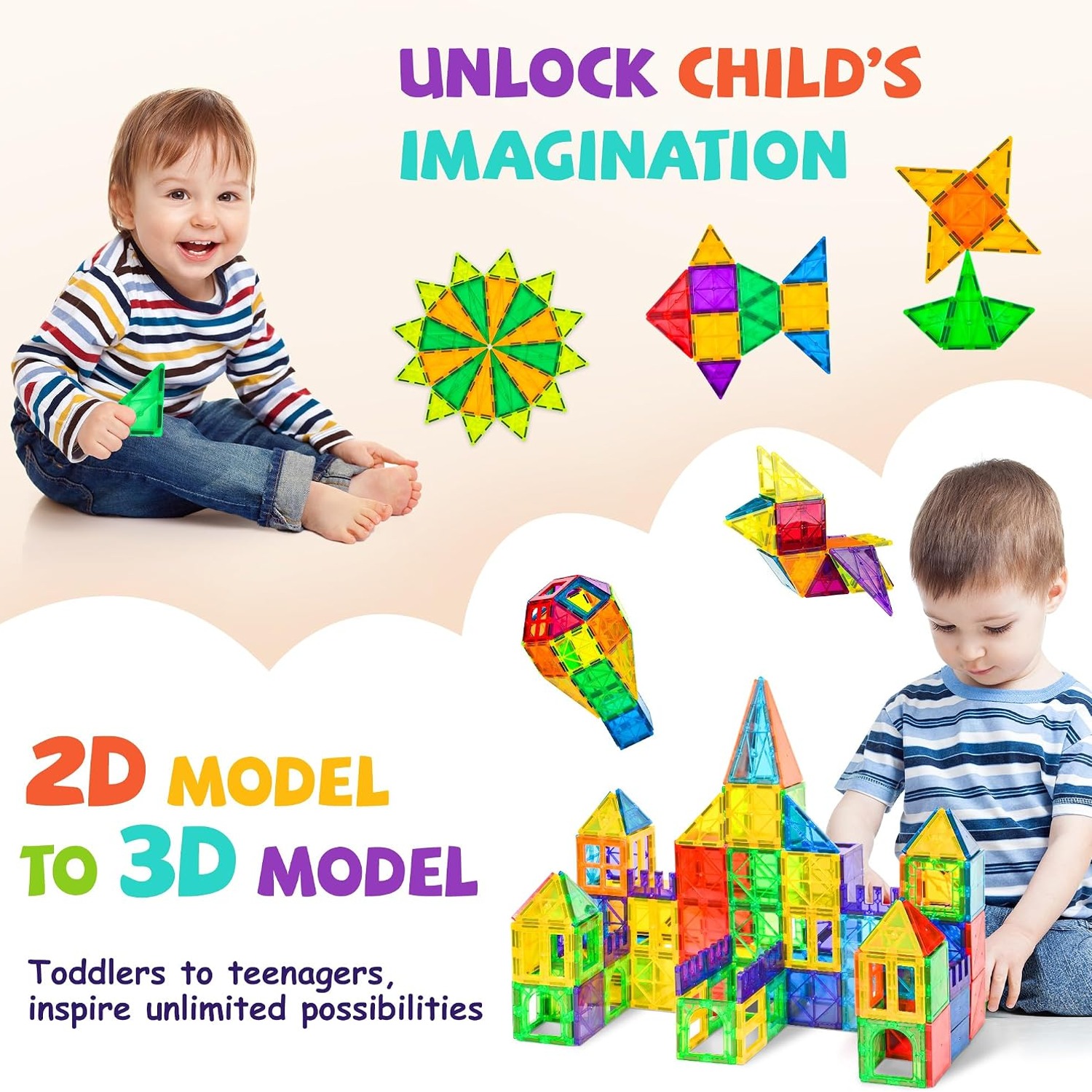
A 120-piece magnetic tile set that lets children build flat patterns or full 3D structures without glue, screws or tools.

The mix includes squares, window pieces, three sizes of triangle, rectangles and two car bases, so builds can roll as well as stand.

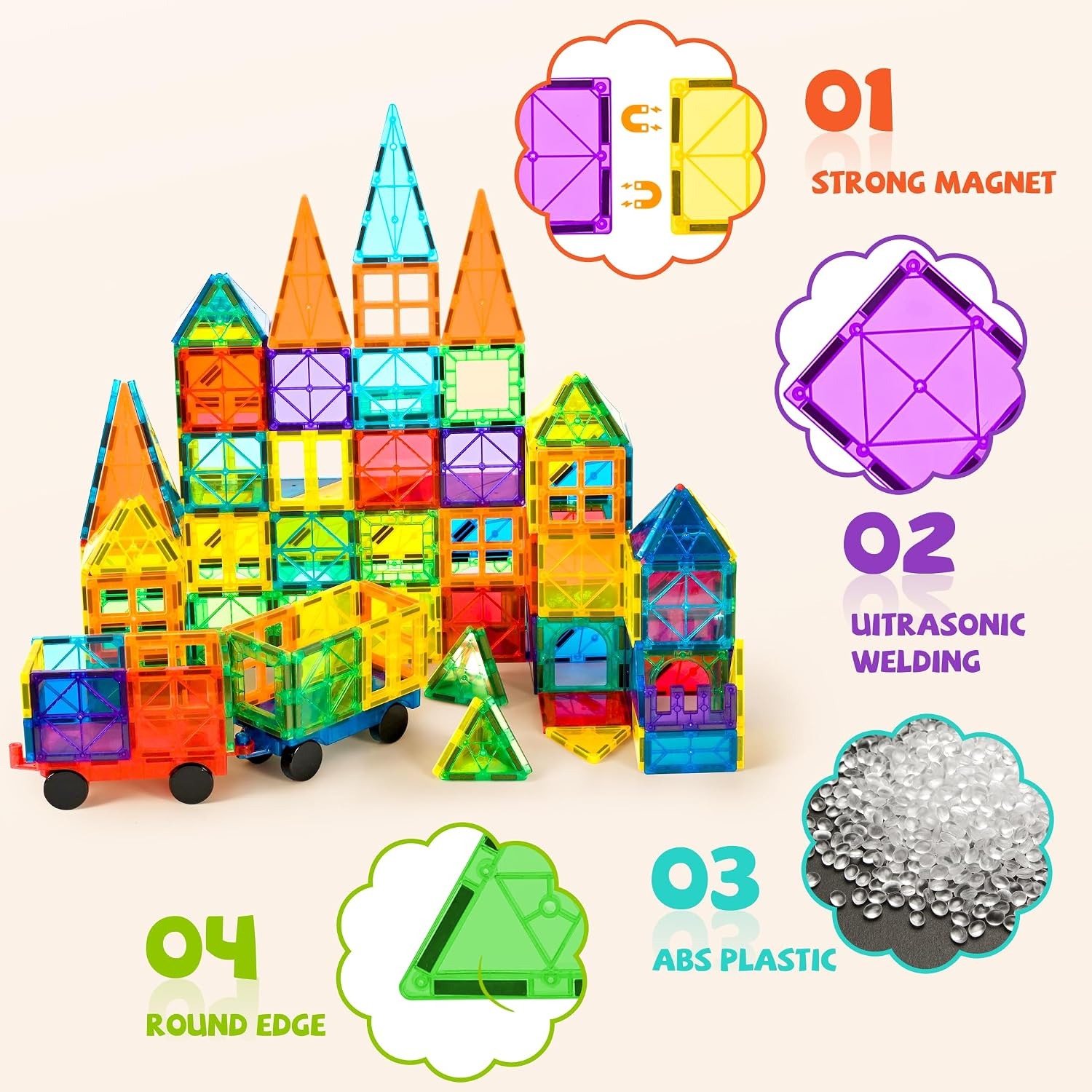
Tiles are made from plastic with rounded corners, which keeps handling comfortable for small fingers.

Pieces are compatible with other magnetic tile brands, so you can merge this set with blocks already in the toy box.

Recommended by the manufacturer for ages 36 months to 14 years, and supplied with an instruction manual for build ideas.

120-Piece Magnetic Tiles STEM Building Set

Magnetic tiles sit in a useful gap between simple stacking blocks and fiddly construction kits. The magnets inside each edge pull the pieces together, so a child who cannot yet line up tiny connectors can still make a wall stand up. That early win matters. It is the difference between a toy that gets packed away in ten minutes and one that gets dragged out every week.

120-Piece Magnetic Tiles STEM Building Set

This set holds 120 pieces across a mix of shapes. There are squares, window panels, small, medium and tall triangles, rectangles and two car bases. The variety is what keeps the building going. Squares alone give you boxes. Add triangles and you get roofs, pyramids and towers. Add the car bases and the whole thing rolls across the floor, which usually sends the play in a new direction.

120-Piece Magnetic Tiles STEM Building Set

The tiles are made from plastic with rounded corners, so there are no sharp edges to catch small hands during a big clean-up sweep. Assembly is not required, and there is no battery, app or screen involved. A child opens the box, tips the pieces out and starts. The included instruction manual gives build ideas for anyone who likes a starting point rather than a blank floor.

120-Piece Magnetic Tiles STEM Building Set

Compatibility is a quiet advantage here. The pieces work alongside other magnetic tile brands, so if you already own a starter pack this becomes an expansion rather than a replacement. Families often find the second set is when builds get ambitious, because there are finally enough squares to make a proper room with a roof that stays on.

120-Piece Magnetic Tiles STEM Building Set

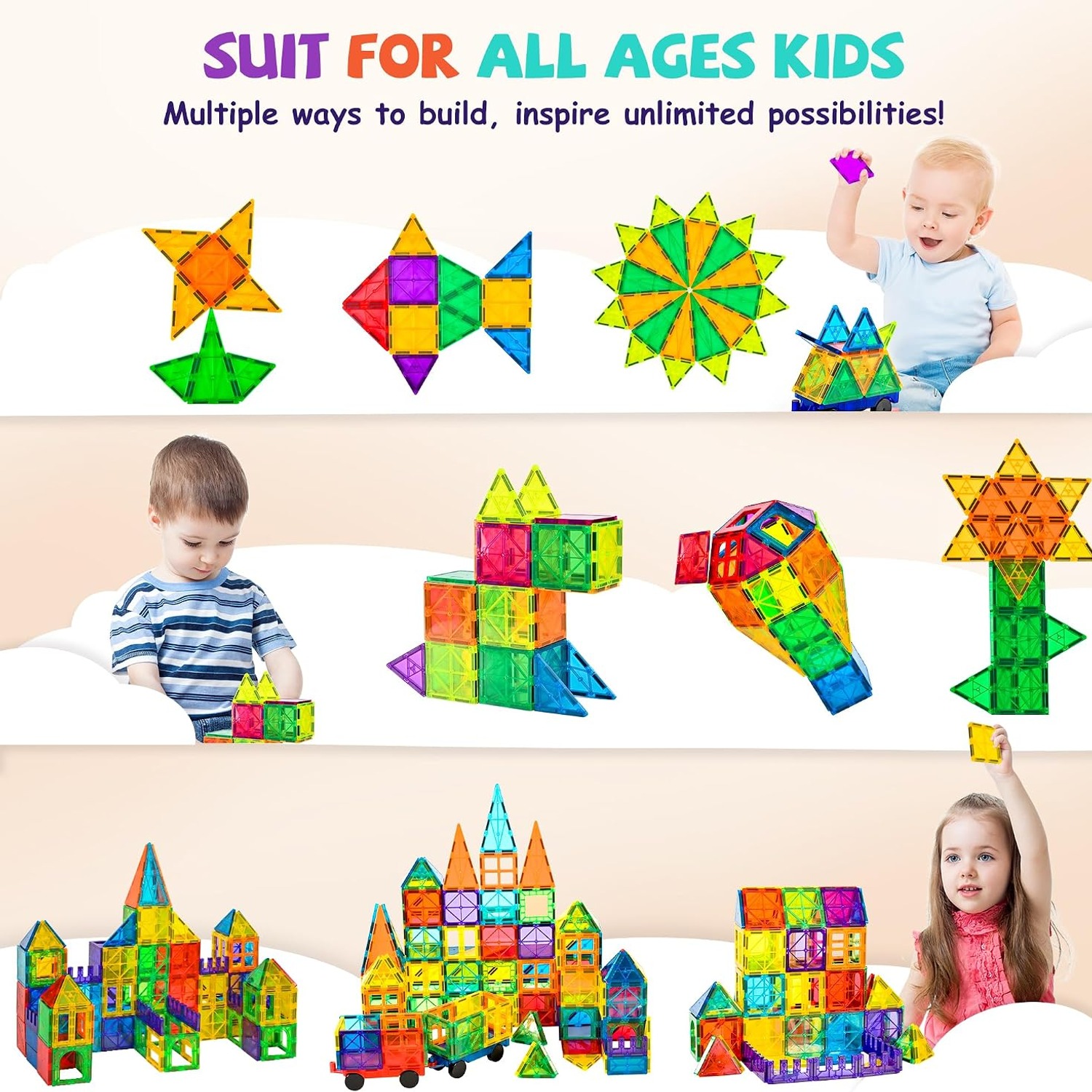
The manufacturer recommends ages 36 months to 14 years, which is a wide window for a single toy. Younger children usually build flat mosaics and short towers. Older children start sketching ideas first, counting pieces, and testing whether a structure will hold. The same box keeps earning its space on the shelf as the building gets more deliberate.

Not sure yet? That is fine.

You can change your mind under our store policy by requesting a return within 15 days of delivery. This is a voluntary policy and does not limit your rights under the Australian Consumer Law.

If it turns up faulty, damaged or not as described, that is on us. The Australian Consumer Law covers you, we pay the return postage, and you can have a repair, a replacement or your money back. Read the full detail on our refunds and returns page, or ask us anything before you order.

Frequently Asked Questions

What exactly is in the box?

The set contains 120 magnetic building pieces plus an instruction manual. The mix covers squares, window panels, triangles in three sizes, rectangles and two car bases. Colours include red, blue, yellow and green among others.

How do magnetic tiles actually hold together?

Each tile has magnets set into its edges. When you bring two edges close, the magnets pull them together and hold the join. There is nothing to click, screw or press, which is why younger children manage them so easily.

What age is this set made for?

The manufacturer recommends ages 36 months to 14 years. Three and four year olds tend to build flat shapes and simple towers, while older children plan multi-level structures. It is one of the better open ended building toy options for a wide age range.

Is this a good first magnetic tile set?

Yes. A 120-piece count is generous for a first set, so a child is not stuck halfway through a build with nothing left. Many starter packs are 30 to 60 pieces, which runs out quickly once a roof is involved.

Will these work with magnetic tiles we already own?

The set is stated to be compatible with other magnetic tile brands. In practice that means edges attract and hold across sets. Tile sizes can differ slightly between makers, so some mixed builds line up better than others.

How many children can play with one set at a time?

Two or three children can usually share 120 pieces without arguing over the last square. Four or more works better if you have a second set. For a classroom building set, most teachers run several boxes per table group.

What are the car bases for?

The two car bases have wheels, so a child can build a body on top and roll it. They tend to turn a static build into a game, with garages, ramps and deliveries. They are one of the most used pieces in the box.

Does the set need batteries?

No. The operation mode is manual, so there is nothing to charge, replace or switch on. It is a fully screen free toy for kids, which is part of the appeal.

Is assembly required?

No assembly is required. The tiles come ready to use straight out of the packaging. You just tip them out and start building.

What material are the tiles made from?

The listed material type is plastic, with a rounded corner design. The specific plastic grade is not stated by the maker.

Are the edges safe for small hands?

The tiles use a rounded corner design rather than sharp square corners, which makes them comfortable to handle and sweep up. As with any small part toy, keep the set away from children under three, in line with the recommended minimum age.

How big is the package?

The item dimensions are 33.6 x 24.3 x 9.9 centimetres. That is roughly the size of a large book box, so it fits on a shelf or in a cupboard without much fuss.

How much does the set weigh?

The weight is not specified by the maker. Based on the piece count and package size it is a hand-carried box rather than anything heavy, but we would rather not quote a figure we cannot confirm.

What can my child actually build with 120 pieces?

Houses with roofs, towers, bridges, pyramids, garages, rocket shapes and flat mosaic patterns are all common. With the car bases, rolling vehicles get added to the mix. The instruction manual gives starting ideas if a child wants a plan.

Is this really a STEM toy or just a building toy?

Both. The educational objectives listed are cognitive development and creative thinking, and the play naturally involves shapes, symmetry, counting, balance and magnetic polarity. Children learn those ideas by testing them, not by being told.

Does it help with maths?

Indirectly, yes. Children sort by shape, count pieces, compare triangle sizes and work out how many squares make a cube. That hands-on sense of geometry tends to stick better than worksheets at this age.

Is this suitable as a gift?

It works well as a birthday gift for 4 year old children through to primary school age. The box is self-contained, nothing needs charging, and the play starts within a minute of opening. It also suits children who already have a small tile set and want more.

Can older children still get something out of it?

Yes. Children around eight to fourteen tend to build structurally, testing spans, overhangs and symmetry. Some work from a sketch first. The piece count is where it matters most for that age, since ambitious builds eat tiles fast.

Will it keep a toddler busy?

A three year old usually starts with flat patterns on the floor and short stacks, then moves to simple boxes. Expect shorter sessions at first that grow longer over a few months. It is one of the steadier construction toy for 3 year olds choices because success comes quickly.

How do I clean the tiles?

Wipe them with a soft, damp cloth and dry them before putting them away. Do not soak the pieces or put them in a dishwasher. Avoid strong solvents, which can dull or craze plastic.

What is the best way to store the set?

A shallow tub or a box with a lid works best, since the tiles stack naturally in colour or shape piles. Some families sort squares and triangles into separate bags, which speeds up big builds. Keep the box out of direct sun and away from heaters.

Will the magnets lose strength over time?

Permanent magnets of this type hold their strength through normal play. Dropping, heat and hard knocks are the usual causes of weakening, so keeping the set off radiators and out of hot cars helps.

Are the tiles safe near phones, cards or tablets?

Keep them away from credit cards, hotel key cards and mechanical watches as a precaution, as with any magnetic product. Modern phones and tablets are not usually affected by toy magnets, but it is sensible not to store the box on top of them.

Can we take the set travelling?

You can, though most people pack a subset rather than all 120 pieces. A zip bag with twenty or thirty tiles makes a handy travel building toy for children on long trips. Check airline rules on magnets if you are flying with the full box.

Do the tiles work on a carpet?

They do, though a flat, firm surface gives better results for tall builds. Carpet absorbs the small knocks that topple towers, which some children prefer. A low table or a hard floor is ideal for anything multi-storey.

What if some pieces go missing over time?

Because the set is compatible with other magnetic tile brands, replacing or topping up is easy. Many families add a pack of extra squares after a year, since squares run out before triangles do.

How does this compare to plastic brick sets?

Bricks reward precision and following instructions, while magnetic tiles reward speed and experimenting. Tiles come apart and rebuild in seconds, so children iterate faster. Plenty of households keep both for different moods.

Is it suitable for children who find fiddly toys frustrating?

Often, yes. There is no force or fine alignment needed, so a build stands up on the first try. That makes it a good fit for children who lose patience with small connectors.

How is the order delivered?

We dispatch within 2 working days. Delivery then takes up to 7 working days by tracked courier, and remote and regional addresses can take longer. Delivery is free on orders of $75 or more, otherwise $27.50 including GST.

What if it is not right when it arrives?

We dispatch within 2 working days. Delivery then takes up to 7 working days by tracked courier, and remote and regional addresses can take longer. Delivery is free on orders of $75 or more, otherwise $27.50 including GST.

Magnetic Tiles Buyer's Guide: Piece Counts, Shapes and What Kids Actually Build

6 min read Kids Playhouse Company

The toy that gets pulled out on day three

Most toys follow a pattern. Big excitement on day one, decent play on day two, then quiet. The ones that survive past the first week usually have something in common. They do not have one correct outcome. A child can come back to them in a different mood and get something different out of them.

Magnetic tiles fall into that group. There is no right answer to a box of squares and triangles. One afternoon it is a castle, the next it is a flat mosaic on the carpet, the week after it is a garage for every toy car in the house. The build gets knocked down and started again without any sense of loss, because rebuilding takes thirty seconds instead of an hour.

The reason this works comes down to how the pieces join. Magnets in the edges do the hard part. A three year old who cannot yet line up a tiny plastic connector can still press two tiles together and watch them snap into place. That first success happens almost immediately, and it is what keeps a child in the game long enough to try something harder.

How magnetic tiles work

Each tile has magnets set into its edges. Because of how magnetic poles behave, tiles will attract in one orientation and gently push apart in another. Children work this out by feel within a few minutes. Flip the piece, try again, it holds. That little bit of trial and error is genuine physics learning, and nobody has to explain it.

Flat shapes fold up into solid ones. Four squares make a box when you stand them in a ring and add a lid. Triangles lean in to make roofs and pyramids. Once a child sees that a flat pattern on the floor can be lifted into a 3D shape, the building changes character. They stop making pictures and start making buildings.

This set includes 120 pieces, which is a genuinely useful number. The mix covers squares, window panels, small, medium and tall triangles, rectangles and two car bases. The window pieces matter more than you would think, because they give a build a front and a purpose. A box is a box. A box with a window is a house, and a house needs people in it.

Who the set suits

The manufacturer recommends ages 36 months to 14 years. That is a wide band, and the play looks quite different at each end of it.

Around three and four, children mostly build flat. They line tiles up in rows, sort by colour and make simple stacks. Towers topple a lot, which is part of the fun. This is the age where the piece count really helps, because sharing with a sibling is easier when there are enough squares to go around.

From about five to eight, the builds get taller and more deliberate. Children start asking for specific shapes, planning roofs and working out why a wall falls over. The car bases get heavy use at this stage, since a rolling build invites a whole story around it.

Older children, roughly nine upward, treat it more like engineering. They test spans, build symmetrical towers and sometimes sketch an idea first. If you are shopping for a best STEM building toy for kids in this age group, the thing to check is piece count rather than complexity, because older children run out of tiles long before they run out of ideas.

Choosing the right set size

People tend to underestimate how many pieces a build eats. A simple cube uses six squares. Put a pitched roof on it and you have used ten or eleven pieces for a single small house. Thirty-piece starter packs feel generous in the box and thin on the floor.

At 120 pieces, two children can build side by side without negotiating over every square. One can make a tower while the other makes a garage, and both get something finished. If three or more children play regularly, or you are stocking a classroom, plan on more than one box.

Compatibility is worth checking before you buy anything. This set is stated to work with other magnetic tile brands, so if you already have a small pack at home, the two merge into one bigger pool rather than living in separate tubs. That is usually the cheapest way to get to a useful piece count, and it is why many families treat their second purchase as an expansion rather than a replacement.

Shapes matter more than colours

Colour gets the attention in photos, but shape mix is what decides how far a build can go. Squares are the workhorse. Triangles do roofs, ramps and anything that needs an angle. Rectangles give you longer walls and better proportions on taller builds. The three triangle sizes in this set, small, medium and tall, let a child match a roof to a wall properly instead of forcing a shape that nearly fits.

The two car bases deserve a mention of their own. They change the play rather than just adding to it. Once a structure can move, children start building roads, ramps and delivery routes. Siblings who were building separately often end up sharing a project.

Looking after them

This is a low-maintenance toy, which is part of why it lasts. Wipe the tiles with a soft, damp cloth when they get grubby and dry them before they go back in the box. Skip the dishwasher and skip strong cleaners, since both can dull plastic over time.

Heat is the main thing to avoid. Do not leave the box on a radiator, on a sunny windowsill for days, or in a hot car. Plastic can warp and magnets do not love high temperatures either. Store the set somewhere ordinary and cool and it will be fine.

For storage, a shallow tub works better than a deep one, because children can see what they are reaching for. Some families sort squares into one bag and triangles into another, which makes big builds faster to start. Others just tip everything in and sort as they go. Both are fine.

As a general precaution, keep magnetic toys away from credit cards, key cards and mechanical watches. It is the same advice that comes with any magnetic product and takes no effort to follow.

As a gift

This set holds up well as a present. There is nothing to charge, no app, no subscription, and the play starts within a minute of the lid coming off. That matters on a birthday morning when a child has four other boxes to get through.

It also suits the awkward case where a child already owns something similar. Because the pieces work with other brands, a second set does not duplicate, it upgrades. The builds that were not quite possible with sixty tiles suddenly are.

If you are buying for a child who gets frustrated with fiddly construction kits, this is often a better fit. Nothing has to be forced or precisely aligned. The pieces either hold or they flip and then hold, and the structure stands up on the first attempt.

The short version

A 120-piece set of magnetic building blocks with squares, windows, three triangle sizes, rectangles and two car bases. Plastic construction with rounded corners, no assembly, no batteries, an instruction manual in the box, and compatibility with other magnetic tile brands. Recommended by the manufacturer for ages 36 months to 14 years.

The case for it is simple. The join is easy enough that a three year old succeeds immediately, and the piece count is high enough that an eight year old does not run out mid-build. That combination is rarer than it sounds, and it is why a box of tiles tends to stay in rotation long after flashier toys have gone quiet.

Browse the shop

Not sure which set size to start with?

Message our team with your child's age and what they already own, and we will tell you honestly whether this set is the right next step.

Ask us a question

Page summary

The 120-piece magnetic tiles set (model ) is a magnetic toy building block set for children aged 36 months to 14 years. It contains 120 plastic pieces in mixed shapes, including squares, window panels, triangles in three sizes, rectangles and two car bases, in colours such as red, blue, yellow and green. The tiles connect by magnetic edges, so no assembly or tools are needed, and the set is stated to be compatible with other magnetic tile brands. Package dimensions are 33.6 x 24.3 x 9.9 cm and an instruction manual is included. The educational focus is cognitive development and creative thinking.